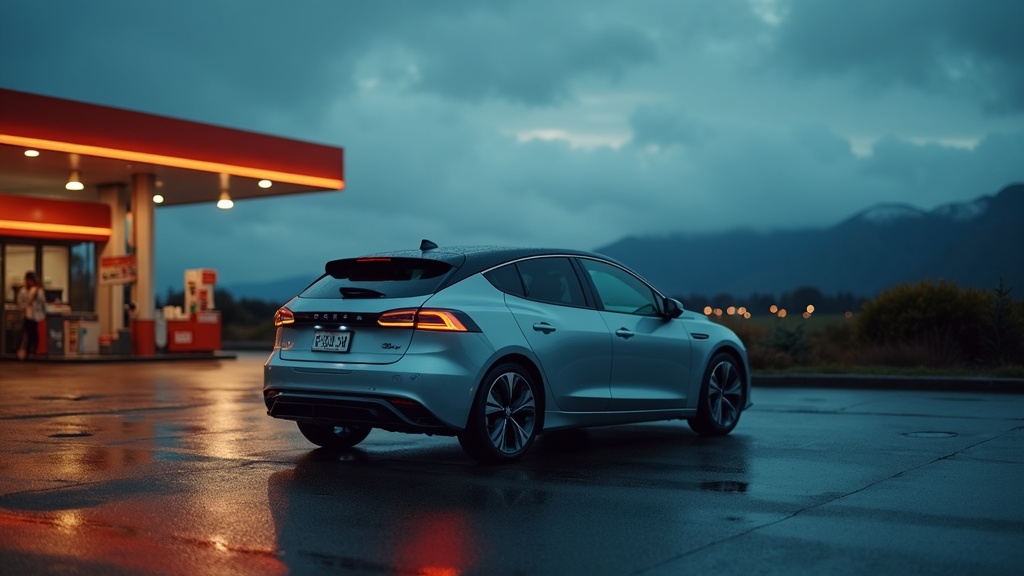
Do EVs still save you money per kilometre in mid-2026?
The NZ Angle
Light EVs in New Zealand have paid road user charges since 1 April 2024, currently set at $76 per 1,000 km. That removed one of the clearest financial arguments for going electric. At the same time, residential electricity in Canterbury sits around 32-36 cents per kWh depending on your retailer and plan, and that figure has moved upward over the past two years. The Clean Car Discount closed at the end of 2023, so there is no longer a purchase subsidy softening the upfront number. What you are left with is a straight fight on running costs, and the maths is closer than the EV sales pitch tends to suggest. Canterbury buyers face a specific consideration: cold overnight temperatures reduce usable battery range by a genuine margin in a Leaf or Atto 3, which affects real-world efficiency figures. That is not a reason to avoid an EV, but it does mean the per-kilometre costs in a Christchurch winter look different from the manufacturer's published figures. The numbers below use local electricity rates, current RUC, and petrol at $2.80 per litre to give a working comparison rather than an optimistic one.
RUC charges are locked in, power prices have climbed, and petrol is hovering around $2.80. We run the real per-kilometre numbers on the Leaf, MG4, and BYD Atto 3 to see if the EV savings story still holds.
The EV running-cost argument used to be simple. No petrol, no RUC, and a government rebate on the way in. That picture no longer exists. RUCs apply, the rebate is gone, and power prices have risen. So the question worth asking in mid-2026 is a plain one: what does it actually cost per kilometre to run a common EV versus a comparable petrol car, using real NZ numbers?
We have looked at three of the most common EVs on NZ roads — the Nissan Leaf, MG4, and BYD Atto 3 — and compared them against a Toyota Corolla hatch running on 91 petrol at $2.80 per litre, which is a reasonable mid-2026 Canterbury pump price.
The numbers, worked through
Start with the Nissan Leaf. The 40 kWh version, which is the most common on the secondhand market here, uses around 16-18 kWh per 100 km in real-world driving. Call it 17 kWh. At 34 cents per kWh for home charging in Canterbury, that is $5.78 in electricity per 100 km. Add RUC at $7.60 per 100 km and you land at $13.38 per 100 km in fuel and road tax alone. A 2018-2020 Leaf will cost $14,000-$20,000 on the used market currently, depending on battery condition and compliance history.
The MG4 Standard Range uses about 15-16 kWh per 100 km on the New Zealand cycle. At 34 cents, that is $5.27 in electricity, plus $7.60 RUC: $12.87 per 100 km. New MG4 pricing starts around $39,990 for the Standard Range. It is a newer, more efficient car than the Leaf, and the per-kilometre cost reflects that.
The BYD Atto 3 Standard Range comes in around 16-17 kWh per 100 km in mixed driving. Similar sums: $5.61 electricity plus $7.60 RUC gives $13.21 per 100 km. New pricing sits around $54,990, though dealer stock prices vary.
Now the Corolla. A 2020-2023 Corolla 2.0-litre hatch averages roughly 7.0-7.5 litres per 100 km in mixed driving. At $2.80 per litre, that is $19.60-$21.00 per 100 km. No RUC. No electricity calculation. Just petrol.
On those numbers, the EVs are saving between $6 and $8 per 100 km over the petrol Corolla. Drive 15,000 km a year and that is $900-$1,200 saved annually on energy costs. Drive 25,000 km and it is closer to $1,500-$2,000.
Where it gets complicated
Those savings are real, but they carry conditions.
The first is the purchase price gap. A tidy used Corolla in that spec costs $22,000-$28,000. A used Leaf with a healthy battery is in a similar bracket, so the comparison there is fairly honest. But a new MG4 or Atto 3 costs $40,000-$55,000, meaning you need to drive a long way and a long time to recover the difference over a comparable new petrol car.
The second condition is charging behaviour. The per-kilometre numbers above assume home charging at the residential rate. Public fast charging changes the equation fast. Most Canterbury public chargers run at 45-75 cents per kWh, and some top-tier DC fast chargers hit 79 cents or more. At 70 cents per kWh, that Leaf costs $29.60 per 100 km in energy and RUC combined. That is more expensive than the petrol Corolla. If you rely heavily on public charging because you cannot charge at home, the savings case weakens considerably.
The third factor is Canterbury winters specifically. The Leaf's 40 kWh battery loses usable capacity in cold weather, and owners commonly report a 15-20% range reduction on frosty mornings. That does not change the per-kWh cost, but it changes how often you are charging and whether range anxiety becomes a genuine inconvenience on longer South Island runs.
What actually tips the decision
For a buyer doing 15,000-20,000 km a year, mostly in Christchurch, with home charging available, the Leaf or MG4 will save money over five years versus a petrol equivalent. The savings are not as dramatic as the 2021-2022 EV pitch suggested, but they are real. Around $5,000-$8,000 over five years on energy costs alone, depending on usage and charging mix, is a genuine number.
For a buyer doing lower mileage, or one who cannot charge at home and relies on public infrastructure, the savings evaporate quickly. At 10,000 km a year with mixed charging, you might save $500-$600 annually. That does not justify a significant purchase premium.
Servicing costs lean slightly in the EV's favour. No oil changes, no cam belts, simpler transmission. Brake wear is lower due to regenerative braking. On the other side, a Leaf battery replacement, if it ever comes to that, is a four-figure job. The MG4 and Atto 3 are newer enough that battery longevity is not yet a proven story in the NZ fleet.
The honest summary is that EVs in mid-2026 still cost less per kilometre to run than petrol, but the margin is narrower than it was two years ago, and the crossover point where you actually come out ahead depends heavily on how you charge, how far you drive, and what you paid for the car.
By Paul Gray. See our editorial standards or email sales@premiumwholesalecars.co.nz with corrections.
More automotive
EV running costs in Canterbury: what Leaf and Aqua PHEV owners are actually paying
RUC charges for light EVs have been in place for over a year. We crunch what Leaf and plug-in Aqua owners in Canterbury are genuinely paying compared to petrol equivalents.
EV running costs after the RUC exemption: what owners are actually paying
The RUC-free ride for light EVs ended in 2024. We've run the actual annual numbers for Leaf, Ioniq 5 and BYD Atto 3 owners commuting in Canterbury against a comparable petrol car.
EV running costs after the RUC exemption ends: do the sums
The RUC exemption for light EVs expired 1 April 2025. Here is what full road-user charges actually mean for Canterbury buyers weighing a used Leaf or Atto 3 against petrol or hybrid alternatives.