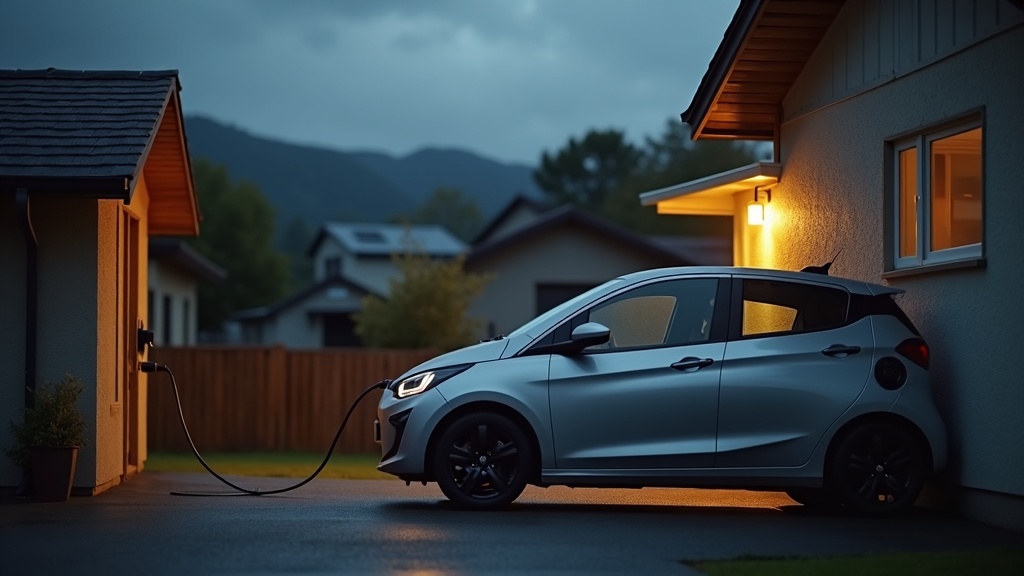
Leaf vs petrol hatch: what the numbers actually say for Canterbury commuters
The NZ Angle
Light EV road user charges came into force in April 2024 at $76 per 1,000 km, ending the free-ride era that made early Leaf ownership look almost too good to be true. For a Canterbury commuter doing around 15,000 km a year, that's $1,140 in RUCs annually, bought in advance and tracked via the odometer. It's not a hidden cost anymore. You budget for it the same way you budget for a warrant. Speaking of which, a Leaf registered in NZ for more than three years sits on annual WoF intervals, same as any other used car here. What does change the calculus is home charging. Most Christchurch households on a standard Meridian or Contact residential tariff are paying somewhere between 28 and 33 cents per kWh, and a 40 kWh Leaf needs roughly 18-20 kWh per 100 km in real-world Canterbury conditions, including cold-weather cabin heating that eats into range more than most owners expect. That puts the per-kilometre energy cost well below petrol at current pump prices, even after you add the RUC back in. The question is whether the gap is wide enough to justify the second-hand premium a Leaf still carries over a comparable petrol hatch on the Christchurch market.
RUC charges for light EVs are now a real line item. We run the actual annual costs for a used Nissan Leaf against a comparable petrol hatchback on Canterbury roads.
The used Leaf market in Christchurch has settled. A clean 2018-2019 40 kWh Leaf with a healthy state of health reading, say 85 percent or better, is sitting at $18,000 to $22,000 on local yards right now. A comparable petrol hatchback, something like a 2018 Honda Fit or a Mazda Demio of similar vintage and mileage, is running $12,000 to $15,000. That's a gap of roughly $5,000 to $8,000 at purchase. Everything else in this comparison flows from that number.
The running costs, built from scratch
Start with fuel. A petrol Fit or Demio is burning around 6.5 to 7.5 litres per 100 km in honest Christchurch driving, which includes the Plains run, some city stop-start, and the kind of cold-morning warm-ups that inflate real-world figures above any claimed figure. At $2.70 per litre, that's roughly $17.55 to $20.25 per 100 km. Over 15,000 km, you're spending $2,632 to $3,037 on petrol.
The Leaf costs less per kilometre to move, but it's not free. Home charging at 30 cents per kWh, a fair midpoint for a Christchurch residential tariff, and 19 kWh per 100 km in real-world use gives you $5.70 per 100 km. Over 15,000 km, that's $855 in electricity. Add the RUC: $76 per 1,000 km, so $1,140 for the year. Total energy and road-user cost for the Leaf: $1,995.
The petrol car wins nothing on that comparison. The Leaf is $637 to $1,042 cheaper to run per year on fuel and road charges alone. Across five years, that's $3,185 to $5,210 saved, which starts to close the purchase price gap meaningfully.
Insurance is broadly similar for both at this price point and age bracket, so it cancels out. Servicing is where the Leaf has a structural advantage: no oil changes, no timing belt, no exhaust to worry about. Budget roughly $150 to $250 per year for tyre rotations, brake fluid, and cabin filter on the Leaf. A petrol hatch of this age needs $300 to $500 per year in routine maintenance, more if it surfaces anything.
What the battery actually does to the maths
Here's where the comparison gets complicated. The 40 kWh Leaf has a known weakness in its thermal management, or the absence of it. The battery degrades faster than a Hyundai Kona or MG ZS EV, and Canterbury summers do it no favours if the car is sitting on a hot driveway and plugged into a fast charger regularly. A Leaf at 85 percent state of health gives you a real-world range of maybe 210 to 230 km in summer, closer to 160 to 180 km on a cold July morning. For the Lincoln Road to Rolleston commuter, that's not a problem. For someone doing regular Christchurch to Timaru runs without planning stops, it creates friction.
Battery replacement on a Leaf is expensive. Nissan New Zealand pricing for a genuine replacement pack sits above $12,000. Reconditioned options exist but vary in quality. If you buy a Leaf with a degraded pack, the economics of this comparison shift badly. The due diligence isn't optional: check the state of health readout before you buy, or walk away.
A petrol hatch from the same era can throw its own surprises, a CVT that's been neglected, a timing chain that's stretched, but the repair costs are generally more proportionate.
The actual five-year picture
If you buy a clean Leaf at $20,000 and a clean Fit at $13,000, the purchase gap is $7,000. Over five years at 15,000 km per year, the Leaf saves you roughly $800 to $1,000 per year in running costs when you net out fuel, RUCs, electricity, and servicing. That's $4,000 to $5,000 over the term. You close roughly half the purchase gap.
Residual values are harder to call. Used Leaf prices have softened since the Clean Car Discount ended in 2023, and they could soften further as newer, better-packaged EVs arrive in volume. The petrol hatch is a known quantity: depreciation is slow and predictable at this age.
For most Canterbury commuters, the Leaf is the cheaper car to own over time if the battery is healthy and the purchase price is disciplined. The break-even point is somewhere between four and six years depending on what you pay upfront and how much you drive. That's not the slam-dunk case EV advocates like to present, but it's a genuine financial argument, built on current numbers, not projected ones.
The honest read: if you can find a healthy 40 kWh Leaf under $18,000 with documented charging history, it makes sense. Pay over $22,000 and the maths gets thin fast.
By Paul Gray. See our editorial standards or email sales@premiumwholesalecars.co.nz with corrections.
More automotive
EV running costs after the RUC change: does a used Leaf still beat a petrol Aqua?
NZTA's light EV RUC rates took effect 1 July 2026. We run the real per-kilometre numbers for Leaf and Ioniq 6 owners against a petrol Aqua and hybrid Corolla at current second-hand prices.
What EV owners actually pay per kilometre under the new RUC rates
NZTA's updated light EV RUC rates are now in effect. Here is what Leaf and Ioniq 5 owners will pay per kilometre in 2026, stacked against a comparable petrol car on real Canterbury distances.
EV road user charges are here: do the numbers still work for Leaf and Aqua buyers?
NZTA's updated RUC rates for light electric vehicles change the cost equation. We work through what Leaf and Aqua owners in Canterbury actually pay per kilometre now.