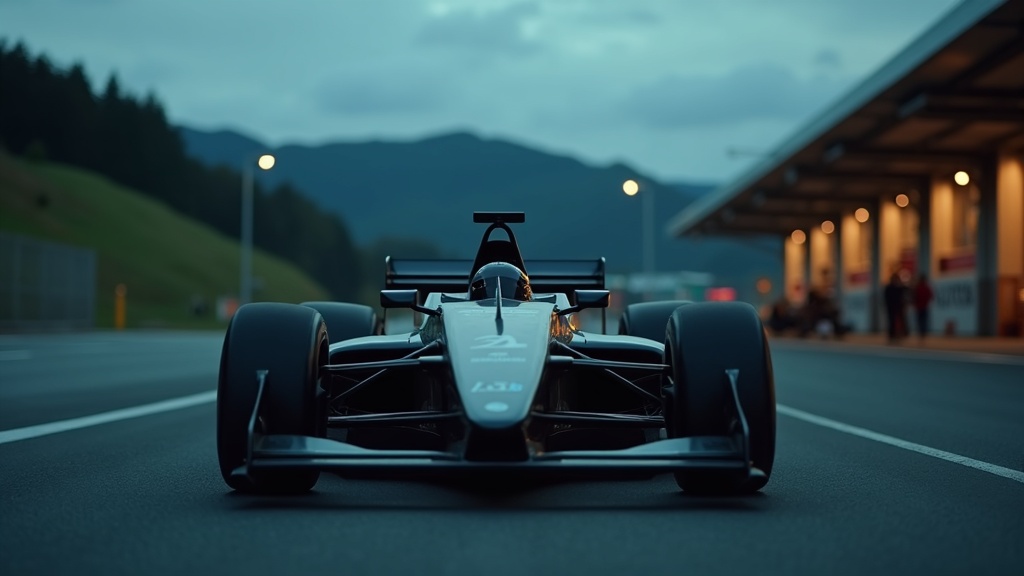
After TRS 2026: which Kiwi graduates are going somewhere
The NZ Angle
The Toyota Racing Series has always sold itself as a winter training ground for international talent, but the NZ pathway argument only holds if local drivers are actually getting somewhere afterwards. The series runs on Hankook rubber, uses the Tatuus FT-60 chassis, and operates at tracks like Hampton Downs and Taupo that don't exactly replicate the aero sensitivity of European circuits. That gap matters. A driver can win TRS rounds and still find themselves underprepared for the downforce loads and tyre management demands of Formula 3 or Formula Regional. The series costs a team-supported Kiwi driver somewhere in the region of $200,000-$250,000 NZD for a full campaign when you factor in travel and logistics, which means the investment calculus is real for families and backers. What TRS does offer is competitive mileage in a spec formula with a peer group that often includes drivers who will go on to F2 and beyond. Whether that peer group is still strong enough in 2026 to give Kiwi graduates a meaningful benchmark is the central question. Liam Lawson's trajectory through TRS to Super Formula and Formula 1 reserve duties remains the reference point everyone cites, and it's a legitimate one, but his path required European F3 and F2 results on top of TRS.
The 2026 Toyota Racing Series has closed out another summer at Hampton Downs and Taupo. The question now is whether its New Zealand graduates are converting track time into real offshore careers.
Lap 18 of the Taupo round, and the fastest TRS time across the entire 2026 season was set not by one of the international hotshots who'd flown in from European junior programmes, but by a 19-year-old from Christchurch running his second full TRS campaign. That single data point doesn't settle anything on its own, but it's the right place to start when assessing what this series is actually producing.
The 2026 field was thinner on the international side than the pre-season entry list suggested it would be. Two European-based drivers withdrew before the Ruapuna round citing scheduling conflicts with Formula Regional testing, which compressed the competitive benchmark for the Kiwi contingent. That's a structural problem the series has wrestled with for several seasons. TRS sits in a scheduling window that increasingly conflicts with northern hemisphere pre-season testing, and teams based in Europe are less willing to send their primary prospects across for five rounds when simulator time and factory testing is available closer to home.
What the graduates are actually doing
Of the six New Zealand-based drivers who ran full TRS 2026 campaigns, three have confirmed offshore programmes for the coming year. One has signed with a British F3 team for a part-season, funded through a combination of family backing and a regional motorsport development grant. One is in negotiations with a Formula Regional European Championship outfit, with a test scheduled before any deal is formalised. The third has taken a development role with an Australian team in their Supercars feeder programme, which is a different kind of career move but arguably a more financially sustainable one given the realities of the junior single-seater ladder.
The other three are in varying states of trying to put budgets together. One has the speed but not the sponsorship. One has the sponsorship interest but results in 2026 that don't yet justify a European commitment. The third is taking a year to race in the South Island series and build a commercial profile before attempting anything offshore. None of that is unusual for a pathway series, but it's worth being straight about: TRS produces options, not guaranteed outcomes.
Lawson's trajectory is the number everyone reaches for, and it's appropriate to. He came through TRS, went to Hitech in Formula 3, progressed to F2, and ended up as a Red Bull junior. But the part of that story that matters most isn't the TRS win. It's that he had the results in Europe to back it up within two seasons of leaving New Zealand. The series gave him mileage and a ranking. What it couldn't give him was the aero sensitivity experience or the tyre management knowledge that European F3 running provides across a full season. He got that the hard way, mid-field in his first F3 year, before the results came.
Whether the pathway argument still holds
TRS at its best does two things. It gives southern hemisphere drivers competitive single-seater kilometres in a window where they'd otherwise be testing on cold European circuits with limited track time. And it gives team managers a head-to-head comparison against international drivers, which a domestic series run in isolation can't provide.
The 2026 season did both of those things, but with caveats. The international field, while competitive, wasn't as deep as 2023 or 2024. When a Kiwi driver beats an international competitor this year, the question of how much that benchmark is worth becomes harder to answer. Series organisers will point to lap times relative to circuit records, and those numbers are legitimate, but team managers in Europe are going to look at who you beat, not just how fast you went.
The Tatuus FT-60 itself is a known quantity on the international scene, which helps. Scouts who've watched the car in Italian F4 and other regional championships understand what the lap times mean. That's a genuine advantage TRS has over running a proprietary or older spec chassis.
The stronger argument for TRS in 2026 is the one that's harder to measure: the experience of managing a five-round campaign, dealing with different circuit layouts and varying weather at venues from Hampton Downs to Highlands, and doing that in a professional team environment. Highlands in particular provides elevation and grip-change challenges that are unusual for a spec formula. A driver who comes out of that with consistent results across different conditions is demonstrating something real, even if the lap times don't tell the whole story.
The series is still delivering pathways. Whether those pathways lead somewhere depends almost entirely on what the driver and their programme do with them in the 18 months that follow.
By Paul Gray. See our editorial standards or email sales@premiumwholesalecars.co.nz with corrections.
More motorsport
Lawson at Red Bull: what the 2026 standings actually say
Liam Lawson is six months into his Red Bull Racing seat. The numbers are in, the pressure is real, and the question of whether he belongs there has a clearer answer now.
Lawson at mid-season: is the Racing Bulls seat delivering?
After the Austrian Grand Prix, Liam Lawson's 2026 campaign sits at a crossroads. We assess the numbers, the car, and whether the step up to a full-time seat is going to plan.
Van Gisbergen leads the way as Stanaway fights for points
Shane van Gisbergen sits near the top of the 2026 Supercars standings after the latest round, while Richie Stanaway continues to find his feet back in the series.