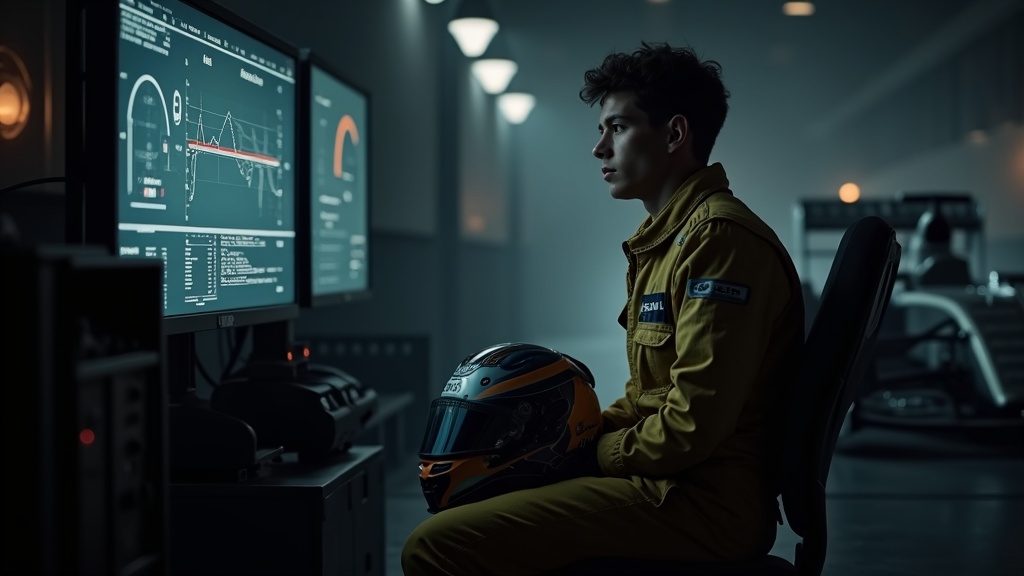
Lawson at Red Bull: what the data says about matching Verstappen
The NZ Angle
For a country with fewer than five million people, New Zealand punches well above its weight in single-seater racing. Scott Dixon has spent two decades proving that at IndyCar level. Lawson is the latest, and arguably the most pressured, case study. He came through Toyota Racing Series at Hampton Downs and Pukekohe, won races, showed the kind of systematic feedback that engineers remember, and worked his way through the Red Bull junior ladder without the fanfare that tends to accompany drivers from larger markets. His promotion to the senior Red Bull seat for 2026 matters in New Zealand partly because it is rare, and partly because the comparison is brutal: his teammate is Verstappen, four-time world champion and the benchmark against which every Red Bull driver since Webber has been quietly found wanting. Kiwi motorsport followers have watched this script before with Webber, who was fast, consistent, and ultimately second in the garage. Whether Lawson is built differently, whether the data from his Racing Bulls season suggests he can close the gap that has swallowed better-resourced drivers, is what this is actually about.
Liam Lawson moves to Red Bull Racing for 2026 after a full season at Racing Bulls. His setup feedback and qualifying numbers offer a realistic read on where he stands against Verstappen.
Liam Lawson spent 2025 doing what Racing Bulls needed him to do: finish races, develop the car, and give the engineers something to work with. He did all three. What he also did, without much fuss, was accumulate the kind of qualifying and race-trim dataset that tells a more complete story than a handful of podium finishes would.
The move to Red Bull Racing for 2026 was confirmed well before the season ended, which is itself a signal. Red Bull's driver management does not confirm things early unless it is confident. The question the paddock has been asking since is a simpler one: can Lawson actually live with Verstappen on a Saturday?
What the qualifying data from Racing Bulls shows
Across Lawson's full season at Racing Bulls, his single-lap pace relative to the car's theoretical maximum was consistently strong in the mid-field. His gap to pole in dry conditions was rarely a product of driver error. More often it was the RB (Racing Bulls) car's aerodynamic ceiling, the tyre preparation window, and the gap between a midfield budget and a front-running one.
The number that matters more is his gap to teammate. Yuki Tsunoda is quick, and his familiarity with the car over several seasons meant Lawson was starting from behind on car knowledge in his first full campaign. Lawson closed that gap across the year. In the second half of the season, he was consistently within two or three tenths of Tsunoda in qualifying trim, and in several rounds marginally ahead. For a driver in his first full season in machinery he did not develop from scratch, that convergence rate is meaningful.
Red Bull's engineering group will have looked at that trajectory, not the absolute gap, and drawn their own conclusions. One hears the chassis feedback reports were particularly noted. Lawson's ability to articulate what the car is doing under braking and in the entry phase is reportedly well above average for a driver his age. That matters at Red Bull, where the setup window on the RB car has historically been narrow, and where Verstappen's feedback loops are famously fast and precise.
The Verstappen problem
Being Verstappen's teammate is not a normal situation. Sergio Perez had 2021 as a decent benchmark, then spent two seasons being lapped by the same machinery and the same setup philosophy. The issue for whoever sits in that second seat is not just pace. It is the way the team naturally gravitates toward optimising for the faster driver, which compounds the gap.
That said, Lawson's profile is different from Perez's at the point of promotion. He is younger, his racecraft is still developing in a positive direction, and he has not had years of being outpaced compressed into his recent history. He arrives with momentum.
The honest read is this: Verstappen will almost certainly be quicker on Saturday in 2026. The meaningful question is by how much, and whether Lawson can limit the gap to the range where it does not affect race strategy. Inside four or five tenths in qualifying, a driver can still be an independent competitive force on Sunday. Beyond that, the team starts solving for one car.
Webber spent most of his Red Bull years in that four-to-six tenths window against Vettel during Vettel's peak. He won races, took poles, and was never a championship threat in those years. The comparison to Lawson is imperfect for several reasons, but the structural dynamic is similar.
What 2026 regulations change, and why it matters
The 2026 technical regulations are a full reset: new power unit architecture, significantly revised aerodynamic rules, ground-effect changes. Every team starts the development cycle again, and the relative performance gaps between drivers at the same team get shuffled in the process.
This is Lawson's largest structural advantage. He is arriving into a new car that Verstappen has also never driven in anger. There is no three-year head start on setup knowledge. The first fifty days of testing will define the baseline for both drivers equally, and Lawson's reported speed at building an understanding of a car from limited running could level that particular playing field.
Red Bull's 2026 programme will be shaped partly by how quickly Lawson can contribute useful data in pre-season. If his feedback from the new car's characteristics is accurate and fast, the team benefits, and Lawson earns himself more setup input earlier in the year. That early influence matters more than it would in a settled regulatory era.
The paddock expectation, from what one gathers, is that Lawson will be a genuine qualifier in the top four or five range fairly regularly, with Verstappen typically ahead of him. Whether that holds into genuine race weekends where strategy splits them, or whether Lawson can occasionally put together a lap that genuinely troubles his teammate, is the story of 2026.
It is not a small ask. But the data from Racing Bulls does not suggest it is an unreasonable one either.
By Paul Gray. See our editorial standards or email sales@premiumwholesalecars.co.nz with corrections.
More motorsport
Lawson at Red Bull: what the 2026 standings actually say
Liam Lawson is six months into his Red Bull Racing seat. The numbers are in, the pressure is real, and the question of whether he belongs there has a clearer answer now.
Lawson at mid-season: is the Racing Bulls seat delivering?
After the Austrian Grand Prix, Liam Lawson's 2026 campaign sits at a crossroads. We assess the numbers, the car, and whether the step up to a full-time seat is going to plan.
Van Gisbergen leads the way as Stanaway fights for points
Shane van Gisbergen sits near the top of the 2026 Supercars standings after the latest round, while Richie Stanaway continues to find his feet back in the series.