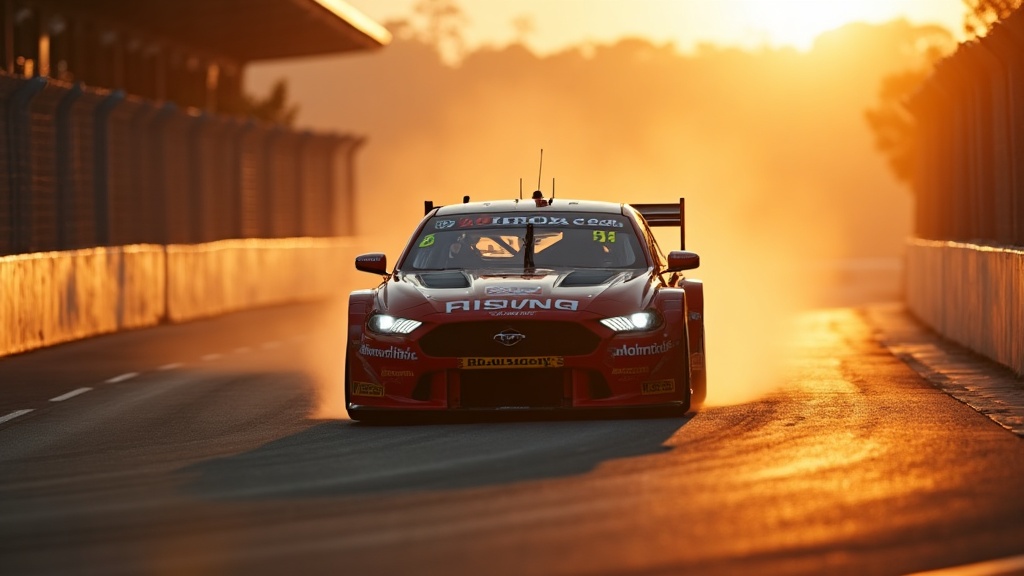
Van Gisbergen back full-time: what his 2026 Supercars return means
The NZ Angle
For most New Zealand motorsport fans, Shane van Gisbergen has always been the thread connecting local club racing to the international stage. He came through the TRS fields, was a regular name in NZ Rally Championship circles, and his three Supercars titles gave the country a genuine standard-bearer in what remains the most technically demanding tin-top series in the world outside the DTM. His move to NASCAR Cup in 2024 and 2025 was followed closely here, but the series' oval-heavy calendar and the sheer foreignness of the machinery made it hard to fully read his performance against known benchmarks. Supercars is different. Kiwi fans understand the circuits, the tyre behaviour on Australian tarmac, the strategic trade-offs at Bathurst. When SvG lines up on a street circuit or at a track like Pukekohe once did on the calendar, the reference points are familiar. His 2026 return, wherever he lands in the standings at the mid-season break, is being watched here not as celebrity news but as a genuine performance question: has the NASCAR stint cost him anything, or has it added something the data will eventually show?
Shane van Gisbergen has returned to full-time Supercars competition in 2026. Here is what his mid-season championship position tells us about the racing, and why Kiwi fans should be watching closely.
Three races into the second half of the 2026 Supercars season, Shane van Gisbergen sits inside the top four in the championship standings. That is not a given for any driver returning from two years in a completely different category on a different continent with a different control tyre and a fundamentally different weight distribution philosophy. The number is worth examining before reaching any broader conclusion.
The Gen3 Chevrolet Camaro he is campaigning is mechanically close to what he left behind, but close is doing a lot of work in that sentence. The current aero package has been refined across two seasons of racing he was not part of. Tyre allocation rules have tightened, which affects how teams approach the second half of longer races. The control Dunlop compound has gone through at least one construction change since his last full campaign. None of these are individually large variables, but together they mean the car he is driving in 2026 is not the car he memorised in 2023.
What the lap data shows
His qualifying pace in the opening rounds of the year was the first real signal. Across the first four qualifying sessions, SvG was consistently within four-tenths of the pole time, which is the bracket you need to be in to convert strategy into race wins rather than just points. The gap to pole was not the story. The consistency was. He is not oscillating between P2 and P12, which is what you tend to see from a driver still rebuilding mechanical feel for a specific platform. His brake markers have been stable round to round, which suggests the muscle memory for this type of car came back faster than many expected.
The race trim picture is slightly more complicated. On circuits where tyre degradation is the primary variable, he has been losing roughly 0.15 seconds per lap more than the front runners in the final stint. That is not a handling problem, and it does not look like setup. It looks more like a tyre management pattern that has not yet been fully re-tuned after two years of NASCAR, where the thermal behaviour of the rubber and the way a driver loads the front axle into a corner are genuinely different disciplines. He is correcting for it. You can see the line adjustments beginning to happen from round five onward. But it is a real gap, and the teams at the front of the championship are aware of it.
The championship picture at the break
The points table at the mid-season break reflects a contest that is not yet resolved in any direction. The leader has a margin that looks comfortable on a spreadsheet but is the equivalent of one bad safety car call or one mechanical failure from evaporating. Van Gisbergen is close enough that a strong Townsville or a clean Darwin weekend puts him mathematically in contention for the second half of the season.
What the standings do not show is how disruptive his presence has been to the tactical decisions of the teams around him. When SvG is in clean air mid-race, other teams start second-guessing their pit windows. That effect was visible in the first half of the year at multiple rounds, where a team running just ahead of him pitted a lap earlier than their data suggested, gave up track position, and ultimately finished behind where their pace warranted. That kind of pressure is a real competitive factor, even if it does not appear in the timing sheets directly.
His Erebus or Triple Eight setup, depending on which team landed him for this campaign, will also have had to recalibrate around his feedback style. He has always been precise about front axle load and has historically preferred a car that rotates early on entry. Whether the current setup has fully met that requirement is hard to know from outside the garage, but his race pace on high-speed circuits suggests the balance is in a workable range.
The second half
Bathurst in October is the race that tends to sort the championship arithmetic in a way that nothing else does. The Mountain rewards a specific combination of mechanical sympathy, strategic discipline, and the ability to manage a co-driver pairing without losing rhythm. Van Gisbergen's record at Bathurst is well documented. The question for the second half of 2026 is whether he can close the tyre degradation gap before the calendar gets to the circuits where it matters most.
If the rate of improvement across rounds five through ten is any guide, the answer is probably yes. He is adapting, and he is doing it at a pace that suggests the underlying skill set is intact. Whether that is enough to win the championship this year is a separate question, and one the data has not yet answered.
By Paul Gray. See our editorial standards or email sales@premiumwholesalecars.co.nz with corrections.
More motorsport
Lawson at Red Bull: what the 2026 standings actually say
Liam Lawson is six months into his Red Bull Racing seat. The numbers are in, the pressure is real, and the question of whether he belongs there has a clearer answer now.
Lawson at mid-season: is the Racing Bulls seat delivering?
After the Austrian Grand Prix, Liam Lawson's 2026 campaign sits at a crossroads. We assess the numbers, the car, and whether the step up to a full-time seat is going to plan.
Van Gisbergen leads the way as Stanaway fights for points
Shane van Gisbergen sits near the top of the 2026 Supercars standings after the latest round, while Richie Stanaway continues to find his feet back in the series.